I Stopped Writing Boilerplate. OpenClaw Did It For Me.
How I went from spending three days on auth and Stripe webhooks to shipping a full AI SaaS in an afternoon, by handing the boring parts to OpenClaw.
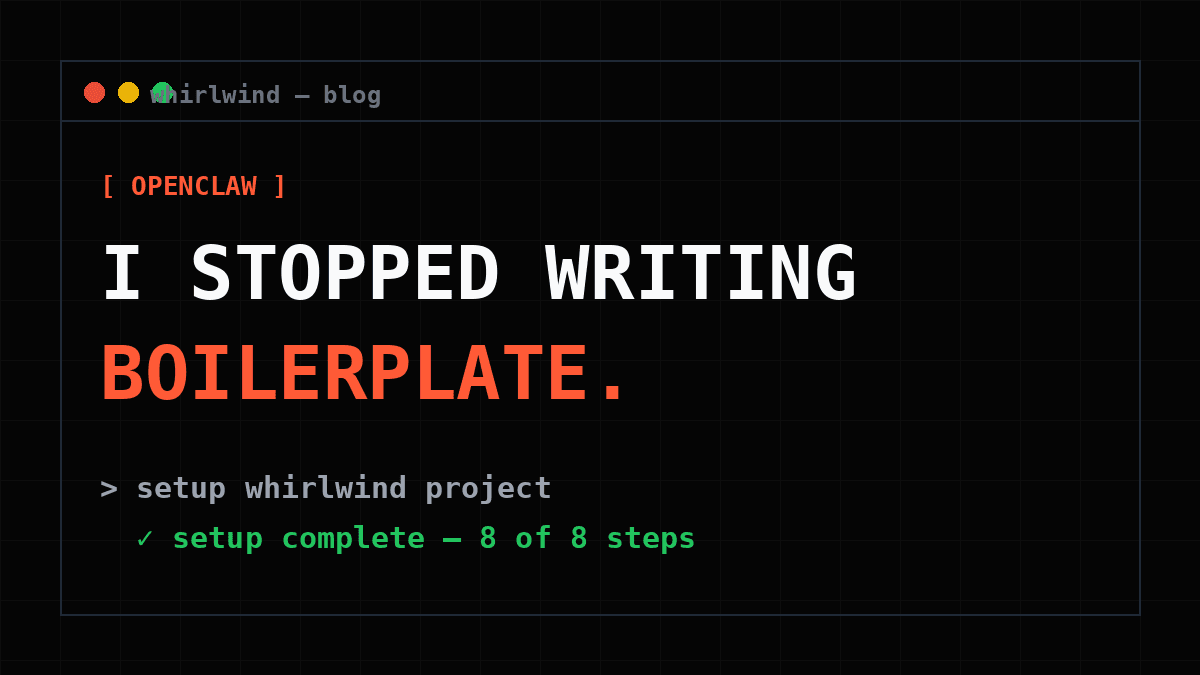
I’ve started a lot of side projects. Most of them never shipped. Not because the idea was bad, but because somewhere around day three, I’d still be debugging a Stripe webhook and wondering why my Supabase row-level security policy was rejecting authenticated requests. By the time I had auth and payments wired up, the inspiration was gone.
That pattern broke for me a few months ago, and I want to write about why. Not as a sales pitch (though I do sell the thing I built) but because the underlying shift is interesting on its own.
The boilerplate problem
Building any modern SaaS means re-implementing the same six or seven systems: auth, payments, a database with proper security rules, transactional email, deploy pipeline, dark mode, SEO. None of these are the product. None of them earn you a single user. They’re table stakes, the kind of work that has to be done and done correctly, but adds zero competitive surface area.
Templates and starter kits have existed for years to solve this. They give you the code. They don’t give you the understanding. You still have to read the README, follow the setup steps, paste your keys into the right places, hope the Stripe webhook tunnels correctly through ngrok, debug the auth redirect loop. The boilerplate is in the file system. The boilerplate work is still in your head.
Enter agentic AI in the terminal
Around the time I started Whirlwind, I’d been using OpenClaw for a few months for general coding work. If you haven’t come across it: OpenClaw is an open-source AI agent that runs on your own machine. It can read your codebase, run shell commands, edit files, and (the part that matters here) it has a concept of skills: markdown files that teach it specific workflows and let it follow them with discipline.
A skill isn’t magic. It’s a structured prompt that says: “when the user wants to do X, here are the phases, here are the validations, here are the things you must not skip ahead on.” OpenClaw reads that and behaves accordingly.
Once I had this in my hands, the boilerplate problem started to look different. The work I was doing for every new project wasn’t hard. It was just unwritten. What if I wrote it down, gave it to the agent, and let the agent walk me through it on every new project?
What four commands looks like in practice
That insight became Whirlwind. The template ships with a custom OpenClaw skill that knows the entire architecture and walks you through setup in four phases. Here’s what that actually looks like:
$ setup whirlwind project

OpenClaw  Got it. I'll set up your Whirlwind project.
          Phase 1 of 4: environment.

          What's the project name?

You       cardflow

OpenClaw  Cardflow. Nice. Creating .env.local now.

          Next: Supabase. Have you already created
          a project, or should I walk you through it?

You       walk me through it
The agent then opens the Supabase dashboard in your browser, tells you exactly which buttons to click, waits for you to paste the project URL and anon key back, validates them, and moves on. When something goes wrong (and something always goes wrong), it diagnoses the error from the actual log output, not from generic guesses.
Stripe is the same. Resend is the same. Deploy is the same. Each phase has checkpoints. You can pause at any point with whirlwind status, walk away, come back tomorrow, and pick up where you left off.
What this changed for me
I’m not going to claim it makes setup instant. Real-world integrations have real-world friction. DNS propagates when DNS wants to propagate. Stripe live mode requires verification. That’s not OpenClaw’s problem to solve.
What it changed is the cognitive cost. I no longer hold the setup checklist in my head. I no longer alt-tab between five documentation pages trying to figure out which order to do things in. I have a conversation. I answer questions. The agent keeps track of progress, makes the right calls in the right order, and tells me when something needs my attention versus when it can handle it itself.
What this means for indie founders
The interesting thing about agent-augmented templates is that they collapse the gap between “I have an idea” and “I have a working product I can show people.” That gap used to be filled with weekends I didn’t have. Now it’s an afternoon.
Which means the bottleneck moves. It’s no longer infrastructure work. It’s the actual product thinking, the distribution work, the customer conversations. That’s where it should have been all along.
If you want to try it, Whirlwind ships with the OpenClaw skill pre-configured. You can get it here. Or if you just want to see how the OpenClaw skill pattern works, the OpenClaw project itself is open-source and worth spending an evening with: github.com/openclaw/openclaw.
Either way, the lesson stuck with me: the boilerplate problem isn’t a code problem. It’s a workflow problem. And workflow problems are exactly what agentic AI is good at.
Related
The 404 That Looks Like an Auth Failure
AI providers retire models on a rolling basis, and a retired model ID returns an error that sends you debugging the wrong thing entirely. How to pin, override, and monitor your model IDs.
Build With AI Without Breaking Prod: The Verification Loop
AI agents are fast and confidently wrong. The fix isn't slowing down. It's a loop: build with the agent, verify with scripts, ship. Here's the loop that runs Whirlwind.
Agent-Driven Development: Contract Files as Architecture Policy
When five developers each have an AI agent, you don't get one codebase. You get five architectures wearing one repo. The fix is contract files: architecture policy as code, plus a CI gate.